
AI Data Centers Are Draining Power in the USA: The Hidden Energy Crisis Explained (2025)
Artificial Intelligence is transforming the United States at lightning speed. From generative AI tools and autonomous systems to real-time data analytics, everything now runs on AI. But behind this innovation boom lies a growing and largely invisible crisis — AI data centers are consuming massive amounts of electricity, putting serious pressure on the U.S. power grid.
In 2025, AI data centers are expanding faster than ever, driven by companies like Nvidia, Microsoft, Google, Amazon, and OpenAI. While AI promises efficiency and economic growth, it is also triggering an energy demand shock that America is struggling to manage.
This article explains why AI data centers are exploding in the USA, how much power they consume, the risks to energy infrastructure, and what the future holds.
Why AI Data Centers Are Growing So Fast in the USA
The United States has become the global hub for AI development. The rise of generative AI, large language models, autonomous vehicles, and enterprise automation has created a huge demand for computing power.
Unlike traditional data centers, AI data centers require high-performance GPUs, specialized cooling systems, and nonstop operation. Training and running AI models consumes exponentially more electricity than standard cloud computing.
Key reasons behind rapid AI data center growth:
- Explosion of generative AI tools
- Increased demand for real-time AI inference
- Growth of AI-powered businesses and startups
- Massive investments by U.S. tech giants
- Government and defense AI adoption
States like Texas, Virginia, Arizona, and Ohio are becoming hotspots for AI data center construction due to available land and tax incentives.
How Much Power Do AI Data Centers Really Use?
AI data centers are energy monsters.
A single large AI data center can consume as much electricity as a small city. Unlike traditional workloads, AI training runs continuously for weeks or months, pushing GPUs at maximum capacity.
Key power facts:
- AI data centers consume 3–10x more power than standard data centers
- A single AI model training run can use millions of kilowatt-hours
- Cooling systems often consume 30–40% of total energy
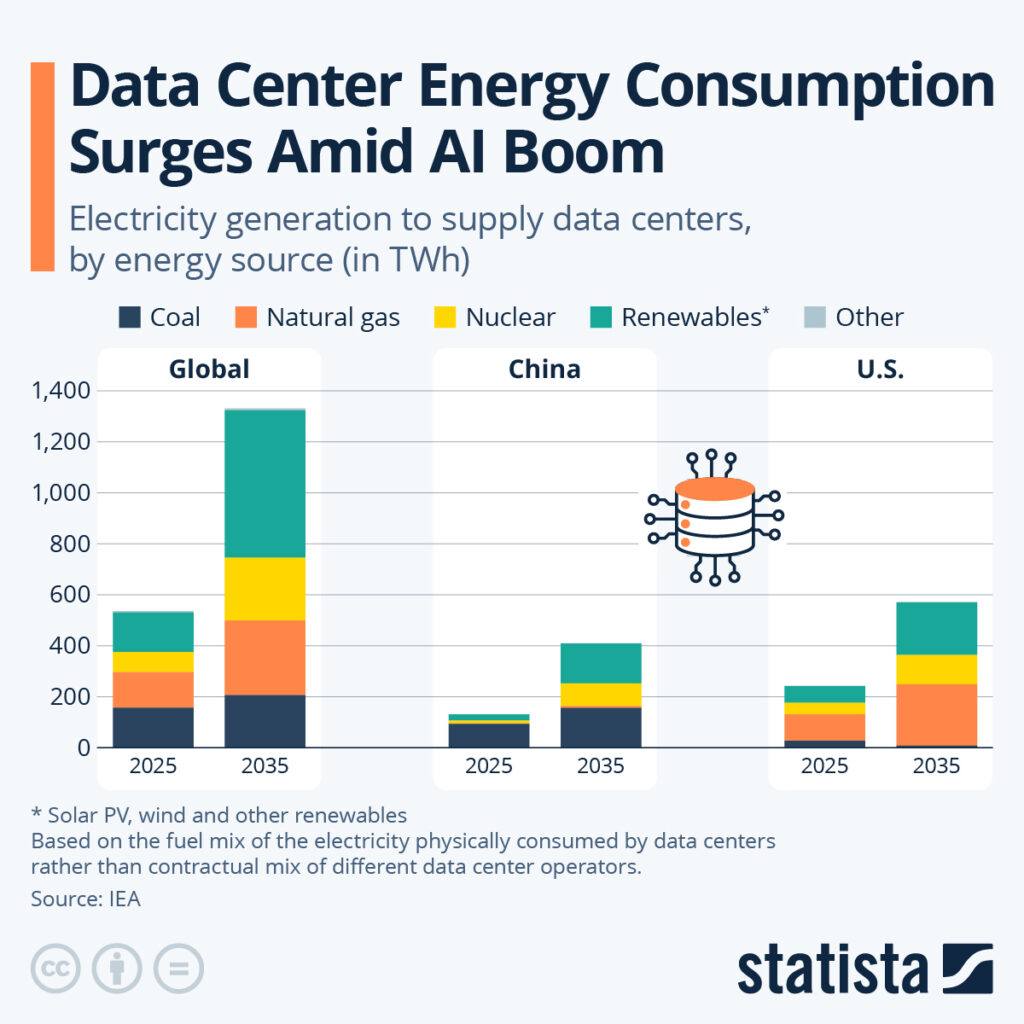
- U.S. data center power demand is expected to double by 2030
According to industry estimates, data centers may soon account for 8–12% of total U.S. electricity usage, largely driven by AI workloads.
The Hidden Energy Crisis Nobody Is Talking About
While AI innovation grabs headlines, the energy infrastructure problem remains underreported.
Many U.S. power grids were not designed to support such concentrated and continuous electricity demand. As a result:
- Local grids are reaching capacity
- Electricity prices are rising
- Power reliability risks are increasing
- Renewable energy supply is under strain
In some regions, utilities are delaying or rejecting new AI data center connections due to grid limitations.
This silent crisis could slow AI expansion if energy solutions are not scaled quickly.
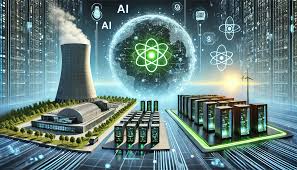
Nuclear, Renewable, or Fossil Fuels: What Powers AI Data Centers?
To keep AI running, companies are exploring multiple energy sources:
1️⃣ Nuclear Energy
Nuclear power is emerging as a stable solution for AI data centers. It provides consistent, carbon-free energy suitable for 24/7 AI workloads.
Some companies are already exploring small modular reactors (SMRs) near data centers.
2️⃣ Renewable Energy
Solar and wind are widely used, but they face reliability challenges due to intermittent supply. AI data centers often require backup power sources.
3️⃣ Natural Gas
Many AI facilities still rely on gas-powered plants to ensure uninterrupted operations, raising environmental concerns.
The energy mix remains controversial as companies balance sustainability with performance.
Environmental Impact of AI Data Centers
AI data centers are also raising serious environmental concerns:
- Increased carbon emissions
- Massive water usage for cooling
- Land and ecosystem disruption
- Higher local temperatures (heat islands)
Water usage is especially alarming. Some AI data centers consume millions of gallons of water per year for cooling, affecting nearby communities.
Why This Matters for the U.S. Economy
Despite the risks, AI data centers are economically significant:
- Create thousands of tech and construction jobs
- Attract foreign investments
- Strengthen U.S. dominance in AI innovation
- Support national security and defense systems
However, unchecked energy demand could:
- Raise electricity costs for households
- Trigger regulatory restrictions
- Slow AI growth due to infrastructure bottlenecks
Balancing innovation with sustainability is now a national priority.
What the Future Looks Like (2025–2030)
Experts predict several major shifts:
- AI-specific energy grids
- On-site power generation for data centers
- Advanced cooling technologies
- Greater use of nuclear and hybrid energy models
- Government regulation on AI energy consumption
Companies that solve the energy problem will dominate the next phase of AI growth.
What Businesses and Consumers Should Know
If you’re a business owner, developer, or investor, this trend matters because:
- Energy-efficient AI will gain competitive advantage
- Power costs may impact cloud pricing
- Sustainability will influence AI regulations
- Infrastructure investments will shape AI adoption
AI is not just a software revolution — it’s an energy revolution.
Final Thoughts
AI data centers are the backbone of America’s AI future, but their explosive growth is creating a hidden energy crisis. As demand accelerates, the U.S. must rethink how it powers intelligence at scale.
The next decade will determine whether AI growth becomes sustainable — or whether energy limits slow the AI revolution.
🔗 INTERNAL LINKS (Paste inside article)
- https://yourtech03.com/cloud-security-infrastructure-data-analytics-usa
- https://yourtech03.com/agentic-ai-what-it-is
- https://yourtech03.com/nvidia-buying-groq